

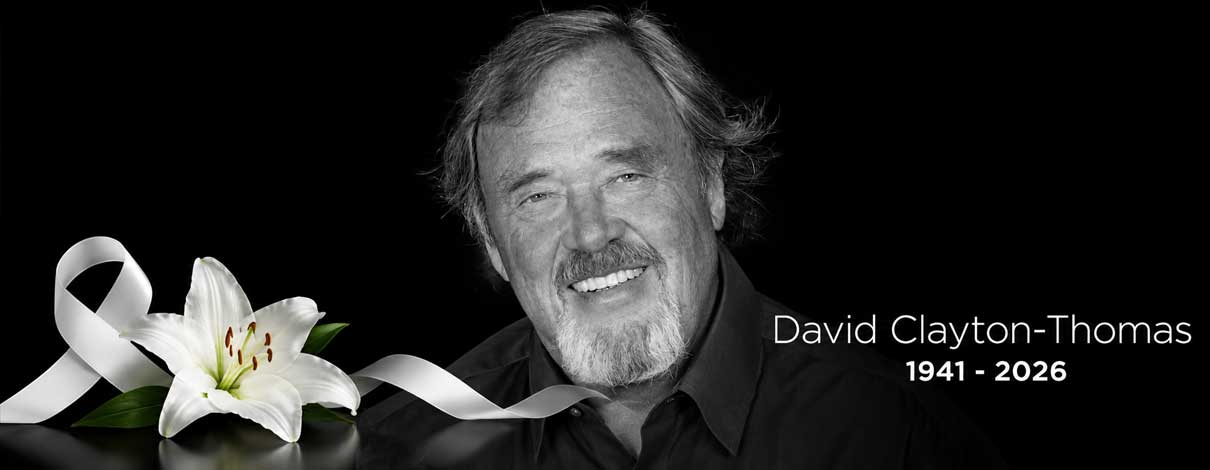
David Clayton-Thomas, 1941–2026: Remembering a Powerful Voice in Canadian Music
From Toronto’s clubs to Woodstock and international success, David Clayton-Thomas became one of Canada’s most recognizable voices.
Few Canadian singers possessed a voice quite like David Clayton-Thomas. Powerful, soulful and immediately recognizable, it carried him from Toronto’s early rhythm-and-blues scene to international stages as the lead singer of Blood, Sweat & Tears.
Clayton-Thomas died at St. Michael’s Hospital in Toronto on June 24, 2026, at age 84. By then, his career had stretched across six decades and included Grammy-winning recordings, enduring songs and a place in the Canadian Music Hall of Fame.
His journey was also distinctly Canadian. Although born in Surrey, England, Clayton-Thomas grew up in Canada and found his musical identity on the streets and stages of Toronto. From there, his voice travelled around the world.
From Toronto’s Music Scene to International Stardom
Finding Music on the Streets of Toronto
Born David Henry Thomsett, Clayton-Thomas experienced a difficult adolescence. After leaving an abusive home, he spent time living on Toronto’s streets and in jail. During one period of incarceration, he taught himself guitar using an instrument another inmate had left behind.
Music offered another direction.
By the early 1960s, he had become part of Toronto’s lively Yonge Street music scene, where rhythm and blues filled clubs along the downtown strip. Ronnie Hawkins recognized his talent, and Clayton-Thomas soon began fronting his own groups, including David Clayton-Thomas and The Fabulous Shays.
He later became closely associated with Toronto’s Yorkville scene. It was there in 1967 that he wrote a song that would eventually become one of his signatures: “Spinning Wheel.”
A New Chapter with Blood, Sweat & Tears
Clayton-Thomas moved to New York City in 1966. A chance connection eventually brought him to the attention of drummer Bobby Colomby, whose band Blood, Sweat & Tears was undergoing major changes. Clayton-Thomas joined the group in 1968.
The combination proved extraordinary.
The band’s self-titled album, released in 1968, became an international success. It topped the Billboard album chart for seven weeks, remained on the chart for 109 weeks and ultimately sold millions of copies around the world.
The album produced three major singles: “You’ve Made Me So Very Happy,” “And When I Die” and “Spinning Wheel.” All three reached No. 2 on the Billboard Hot 100. At the 1970 Grammy Awards, Blood, Sweat & Tears won Album of the Year, part of a five-Grammy night for the album. For Clayton-Thomas, the distance travelled from Toronto’s streets to the top of the international music industry was remarkable.
Taking a Canadian Voice to Woodstock
Success brought Blood, Sweat & Tears to some of the world’s most prominent stages.
The group performed at Woodstock in 1969 and appeared at venues including London’s Royal Albert Hall, Madison Square Garden, the Hollywood Bowl and the Metropolitan Opera. They also performed at the Newport Jazz Festival.
Yet Clayton-Thomas was more than the singer standing at the centre of the band. He was also an important songwriter. In addition to “Spinning Wheel,” he wrote Blood, Sweat & Tears songs including “Lucretia MacEvil” and “Go Down Gamblin’.”
“Spinning Wheel” became particularly important to his legacy. The song entered the Canadian Songwriters Hall of Fame in 2007, four decades after Clayton-Thomas wrote it in Toronto.
Building a Career Beyond the Band
Clayton-Thomas left Blood, Sweat & Tears in 1972 before returning later in the decade. He eventually assumed leadership of the group and continued performing with changing lineups until 2004. His musical identity, however, was never limited to one band.
Clayton-Thomas maintained a substantial solo career and increasingly returned to his roots in blues, jazz and R&B. After relocating to Toronto, he recorded for Canadian independent labels and continued exploring a more intimate musical sound away from the large horn-driven arrangements associated with Blood, Sweat & Tears.
He also appeared on Canadian television, including hosting his own CBC series. In 2010, he performed with the Toronto Symphony Orchestra at Massey Hall, the same year he underwent serious heart surgery. His connection to Canadian music remained strong throughout the later decades of his career.
Canada Recognizes One of Its Great Voices
Clayton-Thomas accumulated an impressive collection of honours.
In 1973, he received a special JUNO Award for his contribution to Canadian music. He was inducted into the Canadian Music Hall of Fame in 1996, followed by the Canadian Association of Broadcasters Hall of Fame in 2008. In 2010, he received a star on Canada’s Walk of Fame.
Those honours recognized more than commercial success.
Clayton-Thomas had emerged from an important period in Toronto music when Canadian performers were building careers in clubs before an international music industry routinely looked north for talent. His rise helped demonstrate how far a Canadian artist could travel without losing the musical influences that shaped him.
Music With a Purpose
Later in life, Clayton-Thomas also used his public profile beyond the stage. He became an advocate for justice-involved youth and supported Peacebuilders Canada, an organization working in restorative youth justice and alternatives to incarceration. In 2020, he wrote and recorded “The System” in support of the organization and participated in fundraising events.
The cause connected with elements of his own story.
Clayton-Thomas knew what it meant for a young person to become involved with the justice system. Decades after his own troubled adolescence, he was able to use the career that followed to support young people facing difficult circumstances.
A Voice That Could Not Be Mistaken
David Clayton-Thomas retired from live performance in 2021, citing his age and two heart surgeries. Even then, he made clear that musical collaboration would continue away from the concert stage. The recordings ensured that the voice would remain.
There is an unmistakable quality to Clayton-Thomas singing “Spinning Wheel,” “And When I Die” or “You’ve Made Me So Very Happy.” The power is obvious, but so are the blues and soul influences he absorbed during his formative years in Toronto.
His story encompassed hardship, reinvention, international fame and a return home.
David Clayton-Thomas helped carry the sound of Canadian music onto the world stage — and left behind a voice that remains impossible to confuse with anyone else’s.
In Memoriam
David Clayton-Thomas
September 13, 1941 – June 24, 2026
Canadian singer-songwriter and former lead vocalist of Blood, Sweat & Tears
Age 84