

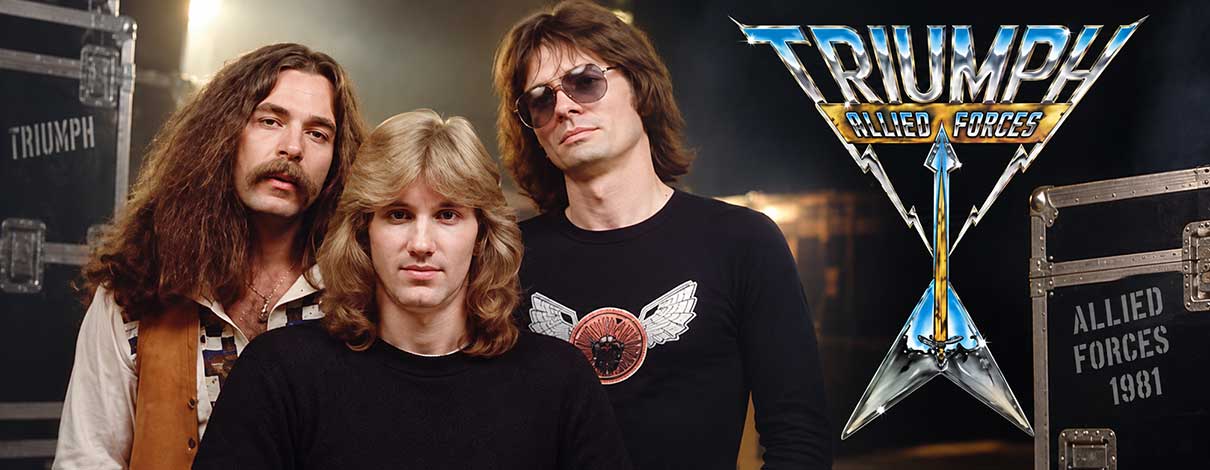
Triumph’s Allied Forces at 45: The Canadian Album That Conquered Arena Rock
September 19, 2026 marks the 45th anniversary of an album that captured Triumph at precisely the right moment.
By 1981, the Toronto power trio of Rik Emmett, Gil Moore and Mike Levine had already established itself as one of Canada’s most ambitious rock bands. Just a Game had opened important doors in the United States, while years of touring had helped build a formidable live reputation.
Then came Allied Forces.
Released on September 19, 1981, Triumph’s fifth studio album brought together powerful guitar-driven rock, memorable melodies and the musicianship that had become central to the band’s identity. It also gave Triumph two of its defining songs: “Magic Power” and “Fight the Good Fight.”
Forty-five years later, Allied Forces remains much more than a collection of classic-rock favourites. It captures the moment when a Canadian band found its sound and proved it could compete on the international arena-rock stage.
A Canadian Band Ready for Something Bigger
Triumph formed in Toronto in 1975. Emmett handled guitar and vocals, Moore played drums and sang, while Levine provided bass and keyboards.
By the end of the decade, the trio had started making serious headway beyond Canada. The 1979 album Just a Game produced “Lay It on the Line” and “Hold On,” while also earning the band its first U.S. gold album.
However, Allied Forces represented another step forward.
Looking back decades later, Emmett described it as the album on which Triumph truly found itself as a band. The material, arrangements and musicianship had come together in a way that suited the three-piece format.
That confidence can be heard throughout the record.
The Metalworks Difference
Allied Forces also represented an important change behind the scenes. It was the first Triumph album recorded at the band’s own Metalworks Studios in Mississauga, Ontario.
Owning the studio changed the recording process.
Instead of constantly watching studio time and budgets, the musicians had more freedom to experiment. Levine later recalled that the band could reject something that wasn’t working and spend the necessary time improving it rather than settling for a performance because the clock was running.
Moore also regarded the album as a turning point in the band’s recorded sound, particularly the drums.
That makes Allied Forces significant for another reason. It wasn’t merely a Canadian album that became successful internationally. Part of the sound behind that success was being developed in a Canadian studio created by the musicians themselves.
The “Magic Power” of Music
Among the album’s defining moments was “Magic Power.”
The song captured something larger than the usual rock-radio subject matter. At its centre was the relationship listeners develop with music — the way a song coming through a radio can offer companionship, escape and encouragement.
It proved perfectly suited to the era. “Magic Power” reached No. 8 on Billboard’s Mainstream Rock chart, becoming one of Triumph’s signature recordings.
Decades later, its message has aged surprisingly well. Technology has transformed how people discover music, but the emotional connection between listener and song hasn’t disappeared.
The delivery system changed.
The magic didn’t.
Fighting the Good Fight
If “Magic Power” represented Triumph’s melodic side, “Fight the Good Fight” showed how effectively the band could combine musicianship with an arena-sized anthem.
The song reached No. 18 on Billboard’s Mainstream Rock chart. Emmett later described it as perhaps the strongest collaboration of song elements and arrangement that he and Moore produced together.
Its message of perseverance became part of the band’s identity.
Triumph had a talent for writing songs that sounded enormous in concert without abandoning melody or musicianship. “Fight the Good Fight” embodied that combination particularly well.
It remains one of the songs most closely associated with the group.
More Than Two Radio Hits
The enduring reputation of Allied Forces understandably centres on its two best-known songs, but the album reveals considerably more about Triumph.
The title track pushes firmly into hard rock. “Ordinary Man” provides contrast and a more reflective perspective. “Fool for Your Love,” “Hot Time (In This City Tonight)” and “Say Goodbye” further demonstrate the band’s ability to move between muscular rock and melody.
Then there is “Petite Etude.”
Emmett’s short classical guitar piece seems almost deliberately unexpected within an arena-rock album. Yet it also demonstrates why Triumph never fit comfortably into a single musical box.
Emmett has explained that guitarists such as Steve Howe of Yes influenced his interest in placing solo instrumental pieces within rock albums. “Petite Etude” continued what became something of a Triumph tradition. Those contrasts helped distinguish the trio.
Triumph could create spectacle, but the musicianship underneath it mattered.
Copyright: @TriumphAlliedForces
Taking Canadian Rock Across the Border
Commercially, Allied Forces delivered.
The album reached No. 23 on the Billboard album chart and achieved platinum status in the United States, representing certified sales of more than one million copies. For a Canadian rock band attempting to establish itself in the enormous American market of the early 1980s, that was significant.
Triumph’s success was also being reinforced onstage.
The group became known for elaborate arena productions featuring sophisticated lighting, lasers and effects. By the Allied Forces period, Moore recalled that touring had reached another level.
The album and the concerts fed one another. Triumph had songs designed to fill arenas — and a stage show capable of making those songs feel even bigger.
An Album Where Triumph Found Itself
Perhaps the most revealing assessment of Allied Forces comes from Emmett himself:
“Allied Forces was the album where Triumph found itself as a band.”
— Rik Emmett¹
That is what makes the album’s 45th anniversary worth marking.
Its importance isn’t simply that it sold well or produced enduring songs. Allied Forces captured three musicians reaching a point where their songwriting, playing, recording and ambitions aligned.
The band had its own studio. Its international audience was growing. Its live production had become increasingly ambitious. And the songs were ready for the arenas Triumph was beginning to fill.
From the Editor
Some albums deserve another listen because they were successful. Others deserve one because they capture a turning point. Allied Forces does both. It documents the moment Triumph’s songwriting, musicianship and arena-sized ambitions came together — and reminds listeners just how much internationally successful rock music was being created right here in Canada.
[1] Source: RikEmmett.com, September 19, 2016. (Context: Rik Emmett, Mike Levine and Gil Moore reflect on the making, impact and legacy of Allied Forces on its 35th anniversary.)