

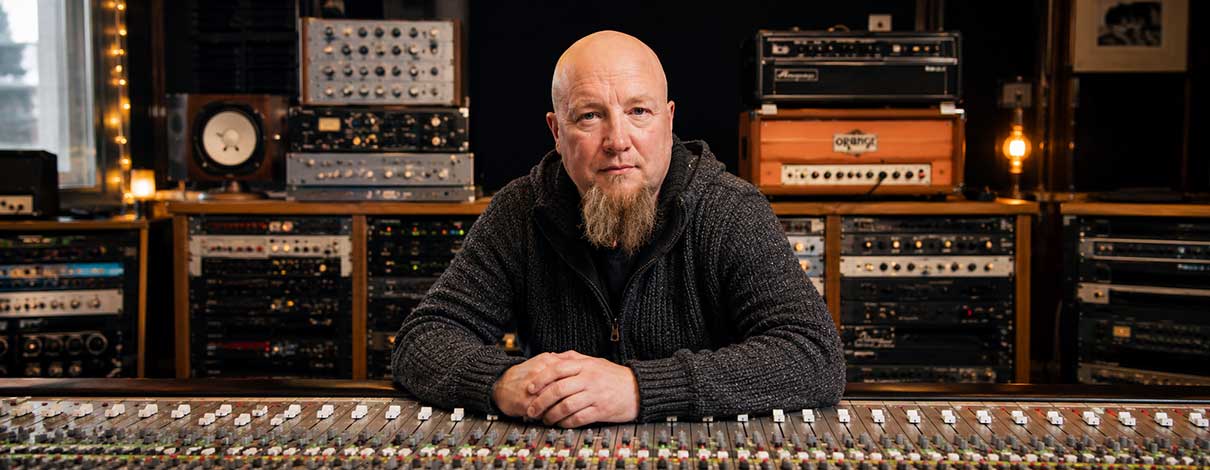
Garth Richardson: Carrying a Canadian Recording Legacy Around the World
From Toronto’s Nimbus 9 to Some of Rock’s Most Influential Records
Career Highlights
- Produced and engineered Rage Against the Machine’s landmark self-titled debut album, earning a Grammy nomination for his engineering work.
- Began working at his father Jack Richardson’s Nimbus 9 studio in Toronto at just 15, with an early credit on Bob Seger’s Night Moves.
- Has worked with major artists including Red Hot Chili Peppers, Rage Against the Machine, Nickelback, Rise Against, Biffy Clyro, Kittie, Mudvayne and 54-40.
- Co-founded Vancouver’s Nimbus School of Recording Arts with Bob Ezrin and Kevin Williams, helping pass professional recording knowledge to a new generation.
Few Canadian record producers inherit a musical legacy quite like Garth “GGGarth” Richardson — and even fewer go on to build an international reputation entirely their own.
Born in Toronto, Richardson grew up immersed in the recording business as the son of legendary producer Jack Richardson, whose work with The Guess Who and other major artists helped establish Canada as a serious force in the international recording industry. Garth entered his father’s Nimbus 9 studio while still a teenager and eventually developed into one of Canada’s most internationally respected rock producers and engineers.
His credits stretch from Rage Against the Machine and Red Hot Chili Peppers to Nickelback, Rise Against, Biffy Clyro, Kittie, 54-40, Mudvayne and Chevelle. Along the way, Richardson has also invested in the next generation of Canadian recording professionals and created a studio environment of his own on British Columbia’s Sunshine Coast.
Growing Up Inside Canadian Music History
For Richardson, the recording studio was almost a second home. His father, Jack Richardson, was one of the architects of Canada’s modern recording industry. His production work included The Guess Who, Alice Cooper, Badfinger and Poco, among many others. The JUNO Awards’ Producer of the Year category has carried Jack Richardson’s name since 2002. Garth began working at his father’s Nimbus 9 facility in Toronto at only 15 years old.
His first album credit came as a second engineer on Bob Seger’s Night Moves. He later worked at Toronto’s Phase One Studios, where his professional education included time alongside influential figures such as Bob Ezrin, Brian Christian and Jack Richardson.
It was an extraordinary apprenticeship. But having a famous surname could only open the studio door. Richardson still had to establish his own sound and reputation.
Finding His Own Place Behind the Console
Richardson’s career eventually took him well beyond Toronto. He spent time in Los Angeles and worked in live sound before developing the production career that would make “GGGarth” a familiar name in rock recording credits.
His résumé became remarkably diverse. Richardson’s production and engineering credits have included Red Hot Chili Peppers, Mötley Crüe, L7, Melvins, Kittie, Mudvayne, Chevelle, Rise Against, Biffy Clyro and Nickelback, among many others. Yet one project in particular would become inseparable from his career.
Rage Against the Machine: A Landmark Recording
In 1992, Richardson produced and engineered the self-titled debut album by Rage Against the Machine. The record combined Tom Morello’s unconventional guitar work, Zack de la Rocha’s explosive vocals and a rhythm section capable of moving between rock, metal, funk and hip-hop influences.
Capturing that intensity without polishing away the band’s raw power was crucial.
The result became one of the defining rock albums of the 1990s. Richardson received a Grammy nomination for his engineering work, while “Killing in the Name” would eventually reach No. 1 in the United Kingdom.
More importantly, the album demonstrated Richardson’s ability to capture the energy of a powerful live band inside a recording studio. That ability became a hallmark of his work.
From Heavy Rock to Canadian Success Stories
Richardson never became confined to one band or one moment. His production catalogue expanded throughout the 1990s and 2000s, including records by Melvins, L7, Kittie, Mudvayne, Chevelle, Rise Against and Biffy Clyro.
Canadian artists remained part of that story. His credits include work with 54-40, Nickelback, Kittie and Big Wreck, while his collaboration with Bob Ezrin on K’naan’s “Wavin’ Flag” connected him to one of the most recognizable Canadian recordings of its era. The song won the 2011 JUNO Award for Single of the Year.
Richardson’s work also brought recognition from Canada’s recording community. He received JUNO nominations for the award that carries his father’s name. Among them were a 2003 Jack Richardson Producer of the Year nomination for work involving The Red and Chevelle and another in 2006 for Hedley’s “Gunnin’” and “Villain.”
There is something particularly fitting about a son being recognized in an award category named for the father who introduced him to the craft.
Building The Farm in British Columbia
Richardson eventually established a very different kind of recording environment. In 2002, he began developing The Farm Studios on a seven-acre property in Gibsons on British Columbia’s Sunshine Coast.
Rather than placing musicians in the middle of a major city, The Farm was designed as a destination where artists could live and work while making a record. The property includes accommodations, allowing recording sessions to become an immersive creative experience.
Richardson even installed recording cables extending into the surrounding woods, making it possible to capture performances outdoors. It reflects an approach that has characterized much of his career: technology matters, but the environment surrounding a performance can matter just as much.
Passing the Knowledge Forward
Richardson’s contribution to Canadian music also extends beyond the records bearing his name. In 2008, he joined producer Bob Ezrin and Kevin Williams to establish the Nimbus School of Recording Arts in Vancouver. The school’s name deliberately connected the project to Jack Richardson’s original Nimbus 9 studio in Toronto.
The connection went even deeper. Ezrin himself had learned from Jack Richardson decades earlier. Now Garth Richardson and Ezrin were helping train another generation in recording, engineering, production and live sound. Nimbus ultimately closed in 2023, but its existence represented an important continuation of Canada’s studio tradition: professionals passing practical knowledge from one generation to the next.
More Than Records
Richardson has also explored ways recording technology can serve people outside the traditional music business. Working with the Music Therapy Ride, he helped develop the Bandwagon, a mobile recording studio designed to bring music-making directly to hospital patients. The first Bandwagon was installed at BC Children’s Hospital in 2012.
It’s another side of a career usually associated with loud guitars and major rock records. The same technology used to make internationally successful albums can also give someone in a hospital room an opportunity to create music.
Quick Facts
| Name | Garth Richardson |
| Also known as | GGGarth |
| Born | Toronto, Ontario |
| Profession | Record producer, recording engineer |
| Career began | 1970s |
| Father | Producer Jack Richardson |
| Early studio | Nimbus 9, Toronto |
| Notable production | Rage Against the Machine |
| Canadian collaborators | Nickelback, 54-40, Kittie, K’naan, Big Wreck |
| Studio | The Farm Studios, Gibsons, British Columbia |
| Music education | Co-founder, Nimbus School of Recording Arts |
Did You Know?
- Garth Richardson was only 15 when he began working at Nimbus 9. One of his earliest credits was on Bob Seger’s classic Night Moves, long before “GGGarth” became an internationally recognized producer.
- Canada’s Producer of the Year JUNO is named after his father. The category became the Jack Richardson Producer of the Year Award in 2002, and Garth himself has subsequently been nominated for it.
Garth Richardson’s career forms an unusual bridge across generations of Canadian recording history. It begins with Jack Richardson and Nimbus 9 in Toronto, passes through one of rock’s landmark albums, stretches across decades of international production work, and eventually leads to The Farm and the training of young recording professionals in British Columbia.
His father’s generation helped prove that world-class records could be made by Canadians. Garth’s generation carried that reputation into an increasingly international music business. And by helping educate the engineers and producers who followed him, Richardson made sure the knowledge accumulated along the way did not simply stay behind the studio door.
That may ultimately be the most Canadian part of the GGGarth story: inheriting a remarkable musical legacy, building something distinct from it, and then passing the craft forward.