

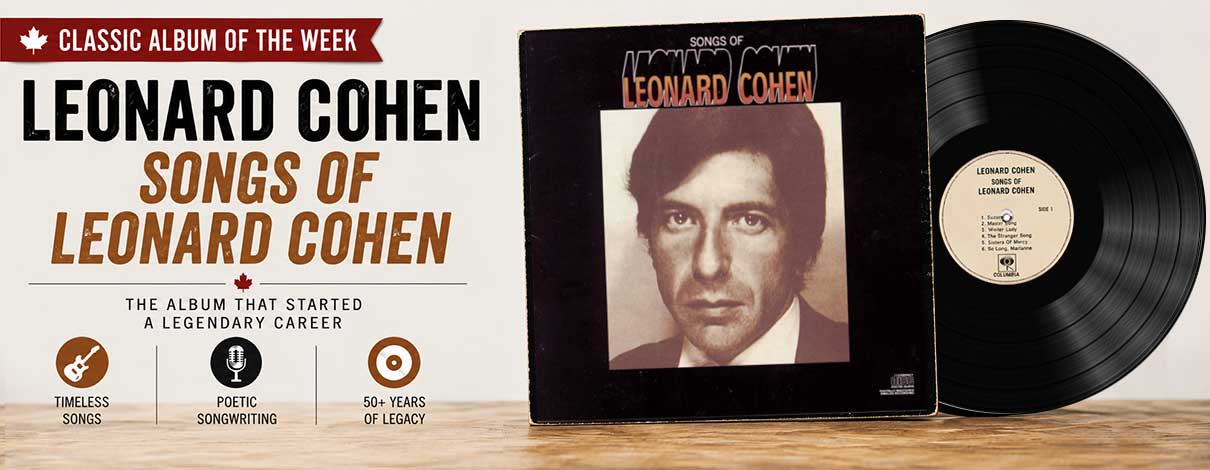
Album of the Week: Leonard Cohen – Songs of Leonard Cohen
The Remarkable Debut That Introduced a Canadian Poet to the World
Released on December 27, 1967, Songs of Leonard Cohen introduced the wider music world to an artist unlike almost anyone else of his generation. Sparse, intimate and deeply poetic, Leonard Cohen’s debut album transformed his literary voice into songs that would eventually become standards.
Cohen was already an established Canadian poet and novelist when he turned seriously toward songwriting. Rather than following the psychedelic sounds dominating the late 1960s, he created something quieter and more contemplative. Nearly six decades later, the album remains a remarkable introduction to one of Canada’s most influential songwriters.
Why This Album Matters
Leonard Cohen did not follow the conventional path to becoming a recording artist. Born in Montréal, he first built his reputation through literature, publishing poetry and novels before pursuing music in his thirties.
That background shaped every aspect of his debut.
Produced by John Simon, Songs of Leonard Cohen placed Cohen’s distinctive voice against restrained arrangements built around acoustic guitar, strings and subtle instrumentation. The production allowed his words to remain at the centre.
Love, loneliness, spirituality and human connection run throughout the record. Those themes would become hallmarks of Cohen’s work during a career that eventually spanned almost five decades.
Track Spotlight
★ Suzanne
One of Cohen’s defining compositions, “Suzanne” began as a poem inspired by Suzanne Verdal and Montréal. Its imagery helped establish Cohen as a songwriter capable of bringing literary depth to popular music.
★ So Long, Marianne
Inspired by Cohen’s relationship with Marianne Ihlen, the song balances affection, separation and memory. It remains one of the most beloved recordings in his catalogue.
★ Sisters of Mercy
Cohen reportedly wrote the song after encountering two travellers during a snowstorm in Edmonton. Its gentle arrangement captures the intimacy that defines much of the album.
★ Hey, That’s No Way to Say Goodbye
A tender examination of love and separation, the song demonstrates Cohen’s ability to communicate complicated emotions with remarkable simplicity.
Album Facts
| Artist | Leonard Cohen |
| Released | December 27, 1967 |
| Genre | Folk, Singer-Songwriter |
| Producer | John Simon |
| Label | Columbia Records |
| Canadian Artist | 🇨🇦 Yes |
Did You Know?
📖 Fact #1: Leonard Cohen was already an accomplished poet and novelist before releasing his first album at age 33, making his path to international music success highly unusual.
🎵 Fact #2: “Suzanne” was recorded by Judy Collins before Cohen released his own version, helping introduce his songwriting to American audiences before his debut album appeared.
Historical Significance
Songs of Leonard Cohen helped establish a different kind of singer-songwriter. Cohen did not depend on vocal power or conventional pop structures. Instead, his strength came from language, atmosphere and the ability to explore complex human experiences through deceptively simple songs.
The album’s reputation continued to grow long after its release. Artists across folk, rock, alternative and contemporary music have recorded Cohen’s compositions, while his approach to lyric writing influenced generations of songwriters.
It also marked the beginning of an extraordinary recording career that would eventually make the Montréal-born artist one of Canada’s most internationally respected cultural figures.
Why We Chose This Album
 Songs of Leonard Cohen represents the moment a celebrated Canadian literary voice found another way to tell stories.
The album is understated, thoughtful and unmistakably Cohen. Songs including “Suzanne” and “So Long, Marianne” have survived changing musical trends because their stories and emotions remain universal.
That combination of poetry, songwriting and enduring influence makes Songs of Leonard Cohen an essential addition to the Classic Album of the Week series.
🎧 If You Like This Album…
- Joni Mitchell – Blue (1971)
- Gordon Lightfoot – Sundown (1974)
- Neil Young – Harvest (1972)
Great albums never fade—they become part of our lives. Every week, The Maple Music Café Lounge and Maple Music Café celebrates the recordings that continue to inspire generations of music lovers.