

In Conversation with Triumph: Five Decades of Canadian Rock Excellence
Gil Moore, Rik Emmett and Mike Levine Reflect on Triumph’s Music, Milestones and Enduring Legacy
For more than 50 years, Triumph has stood as one of Canada’s defining rock bands. Known for their electrifying live performances, technical musicianship and unforgettable anthems, Gil Moore, Rik Emmett and Mike Levine helped shape the sound of arena rock throughout the 1970s and 1980s. Their concerts became legendary, their albums earned 25 Gold and Platinum certifications across Canada and the United States, and their influence continues to inspire generations of musicians around the world.
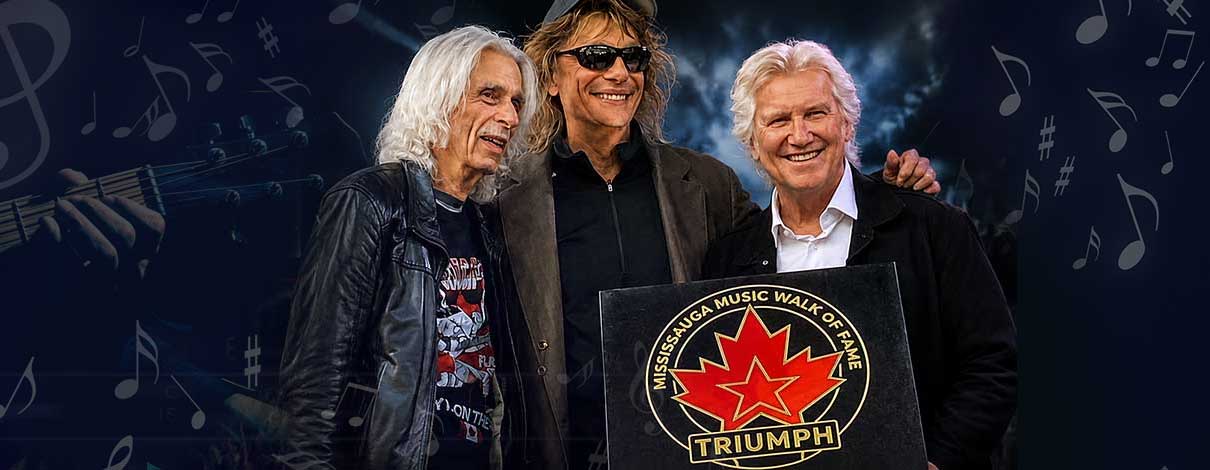
Recognition has followed throughout their remarkable career. From induction into the Canadian Music Hall of Fame, Canada’s Walk of Fame, the Metal Hall of Fame, and most recently receiving the inaugural Mississauga Music Walk of Fame ICON Award in 2025, Triumph’s place in Canadian music history is firmly established.
For Maple Music Lounge, the band reflects on an extraordinary journey built on friendship, perseverance and a lifelong passion for making music.
More than five decades have passed since Triumph first came together. Looking back today, what do each of you remember most about those early days?
Gil Moore: What I remember most is the ambition. Mike and I knew we wanted to build something serious, but finding Rik was the piece that brought the musical identity into focus. We were young, determined and probably fearless because we did not fully understand how difficult the road would become. We rehearsed, learned about production and worked on every part of the operation ourselves. There was no separation between the music and the business. We were building the band from the ground up.
Rik Emmett: I remember the excitement and the sense that everything was still possible. Gil and Mike came to see me performing with another group, and shortly afterwards we played together in Gil’s basement. It did not become perfect overnight, but there was enough chemistry, ambition and shared purpose to see a future. Gil and Mike understood areas of the business and production that were new to me, while I was eager to contribute songs and expand the musical side. We were learning from one another while trying to discover what Triumph could become.
Mike Levine: The early days were about resourcefulness. We did not have unlimited money or a large organisation behind us, so everyone had to contribute. We thought about the records, the arrangements, the equipment, the promotion and how to get the band in front of people. There was a strong sense that we were partners building something together. Once we heard Rik sing and play, we knew we had found the missing part of the band.
Triumph became known for spectacular live performances long before elaborate arena productions became common. How important was the live concert experience in defining the band’s identity?
Gil Moore: It was absolutely central. We never wanted audiences to feel that they were simply watching three musicians reproduce an album. A concert needed to be an event. The lighting, lasers, effects, sound and staging were all designed to support the emotion of the music. We invested heavily in production, sometimes before it was financially sensible, because we believed the audience deserved a complete experience.
Rik Emmett: The production gave the music another dimension. Triumph’s songs often contained dynamics, drama and a sense of optimism, so the visual presentation helped amplify those qualities. At the same time, the spectacle could never replace the playing. We still had to perform as a trio, sing the harmonies and deliver the songs. The goal was to combine musicianship with theatre rather than allow one to overshadow the other.
Mike Levine: The live show separated Triumph from many other bands. We approached it almost like a travelling production company. Every cue and technical element had to work with the performance. The audience might not have known everything happening behind the scenes, but they could feel the scale and attention to detail. That became part of the Triumph identity.
Editor’s Note: Triumph earned an international reputation for combining exceptional musicianship with innovative lighting, lasers and stage production, helping establish the blueprint for modern arena rock performances.
In 1983, Triumph performed at the legendary US Festival before an enormous audience. Does that performance still stand out as one of the defining moments of your career?
Gil Moore: It certainly stands out because of the scale. When a band walks onto a stage and sees a crowd extending farther than the eye can comfortably take in, there is an extraordinary surge of energy. It was also a very competitive day, with some of the biggest hard-rock bands in the world appearing on the same bill. We knew we had to deliver a powerful performance and make every minute count.
Rik Emmett: The US Festival has become one of those moments that grows in historical importance over time. During the performance, however, you are concentrating on the next song, the next note and the connection with the audience. It was exciting, but it was also a demanding professional situation. Looking back at the footage now, it is easier to appreciate the magnitude of the event and how strongly the band performed that day.
Mike Levine: It was a remarkable platform for Triumph. We had played large festivals and stadiums before, but the US Festival brought together an audience and media presence on an extraordinary scale. It demonstrated that three musicians from Mississauga could stand on one of the world’s biggest stages and belong there. That is a memory no one in the band could ever forget.
Songs such as Lay It on the Line, Magic Power, Fight the Good Fight, Hold On, and Somebody’s Out There continue to resonate with fans. Are there certain songs that have taken on new meaning over the years?
Rik Emmett: “Magic Power” has probably taken on the greatest additional meaning because listeners have told us how music helped them through difficult moments. When a song is written, the writer begins with a personal idea, but the audience eventually makes it their own. “Hold On” and “Fight the Good Fight” have also grown beyond their original settings. Their messages become different depending on what a listener is facing.
Gil Moore: “Fight the Good Fight” continues to feel timely. Every generation faces periods of uncertainty, and people still respond to music that encourages resilience without pretending life is easy. I also think “Lay It on the Line” has remained powerful because it is direct. There is an honesty in the title and the performance that people recognise immediately.
Mike Levine: What is most rewarding is seeing these songs find audiences who were not alive when the records were released. The songs now appear in sports broadcasts, streaming playlists, online videos and cover performances from around the world. That gives them a new context. They are no longer connected to only one period of Triumph’s history.
The documentary Rock ‘n Roll Machine introduced Triumph’s story to a new generation of fans. What was it like watching your own history unfold on screen?
Gil Moore: It was emotional and occasionally surreal. Triumph accumulated an enormous archive of concert footage, interviews and behind-the-scenes material. Seeing those images assembled into a coherent story brought back details that had been forgotten. The documentary also presented the difficult periods honestly. That was important because a meaningful story cannot include only the triumphs and ignore the conflicts.
Rik Emmett: Watching it required a degree of distance and humility. There were wonderful memories, but there were also complicated moments involving the partnership and my departure. Time changes perspective. Events that once carried anger or disappointment can eventually be understood with greater compassion. The film allowed us to recognise what the three of us accomplished together despite our differences.
Mike Levine: The documentary reminded us how much happened in a relatively concentrated period. When a band is touring and recording constantly, there is rarely time to step back and understand the larger story. The film allowed us—and the audience—to see the scale of the work, the production and the commitment behind Triumph. It was especially gratifying to see younger viewers discovering the band through the documentary.
Editor’s Note: Released in 2021 by Banger Films, Rock ‘n Roll Machine premiered at the Toronto International Film Festival, celebrating the band’s remarkable career while introducing Triumph to audiences who may not have experienced their original tours.
Your music has inspired countless artists, and the Triumph tribute album featuring musicians such as Dee Snider, Slash and Nancy Wilson speaks to that influence. How does it feel knowing your songs continue to inspire fellow musicians?
Gil Moore: It is both flattering and surprising. You know the fans care about the music, but you do not always realise how deeply other musicians have connected with it. Hearing artists reinterpret the songs instead of simply copying the original arrangements was especially rewarding. Nancy Wilson, for example, brought a completely different character to “Fight the Good Fight,” while still respecting the heart of the song.
Rik Emmett: A song is fortunate when it survives beyond its original recording. It is even more fortunate when another artist finds something personal within it. The tribute album demonstrates that these compositions can accommodate different voices, styles and interpretations. That is one of the greatest compliments a songwriter can receive.
Mike Levine: The album felt like a musical community coming together. Some of the participating artists were longtime friends, while others had admired Triumph from a distance. My role involved reaching out, discussing songs and helping bring the project together. The enthusiasm was genuine. Hearing musicians of that calibre put their own identities into Triumph’s catalogue was extremely moving.
Throughout your career, you’ve received numerous honours, including induction into the Canadian Music Hall of Fame, Canada’s Walk of Fame, the Metal Hall of Fame, and, most recently, the inaugural Mississauga Music Walk of Fame ICON Award. Which of these recognitions has meant the most personally?
Gil Moore: Every honour carries a different meaning. The Canadian Music Hall of Fame represented recognition from the national music community. Canada’s Walk of Fame connected the band with a broader cultural history, while the Metal Hall of Fame acknowledged Triumph’s influence within hard rock. Recognition from Mississauga is particularly personal because that is where the band was built. It brings the story home.
Rik Emmett: Awards can never replace the experience of creating music or connecting with an audience, but they offer moments of reflection. The Canadian Music Hall of Fame was significant because it helped bring the three of us back into the same room after many years apart. The hometown recognition also means a great deal. Triumph began as three people rehearsing and planning in Mississauga, so being honoured by that community completes a remarkable circle.
Mike Levine: It is difficult to select only one. National honours recognise the scale of what Triumph achieved, while the Mississauga recognition acknowledges where the work began. The most meaningful aspect of every induction is that Gil, Rik and I can receive it together. Whatever disagreements existed over the years, the music and the accomplishments belong to the partnership.
Editor’s Note: Triumph was inducted into the Canadian Music Hall of Fame in 2008 and Canada’s Walk of Fame in 2019. In 2025, Triumph became the first recipients of the Mississauga Music Walk of Fame ICON Award, recognising not only their international success but also their lasting contribution to the city’s cultural identity and Canada’s music legacy.
Despite achieving international success, Triumph has always proudly embraced its Canadian roots. How important has that identity been throughout your career?
Gil Moore: It has always been fundamental. We were a Canadian band, built in Mississauga, and we were proud to carry that identity wherever we performed. Canada gave us the environment in which we learned our craft and developed the band. Even when our touring schedule became heavily focused on the United States, we never viewed our Canadian background as something to minimise.
Rik Emmett: Canadian identity can be difficult to define because the country contains so many different influences and traditions. For Triumph, it meant being hardworking, adaptable and perhaps slightly underestimated. We learned to cross borders both musically and geographically. The music was intended for an international audience, but the perspective behind it was unquestionably Canadian.
Mike Levine: Being Canadian helped shape the way we approached the business. We understood that we could not wait for the international industry to discover us. We had to build an audience, take risks and prove ourselves market by market. We were always happy when our success helped draw attention to the quality of Canadian musicians and production.
Rock music continues to evolve, yet Triumph’s catalogue remains relevant more than 50 years later. What do you think has allowed your music to stand the test of time?
Rik Emmett: Songcraft is the foundation. Styles, production techniques and formats change, but a strong melody, a meaningful lyric and an emotional performance can continue communicating. Triumph’s music also crossed several boundaries. There was hard rock, progressive music, acoustic guitar, pop melody and blues. That variety gave the catalogue more than one way to reach listeners.
Gil Moore: The songs carried messages of hope, determination and self-belief. Those ideas are not tied to one decade. We tried to make music that energised people and gave them something positive without becoming sentimental. The records also captured real performances. The playing, singing and arrangements came from musicians pushing one another to improve.
Mike Levine: The catalogue has remained available and has continued to travel through radio, sports, streaming, video platforms and word of mouth. However, exposure alone cannot create longevity. People return because the records still sound honest. Triumph believed in what it was playing, and audiences can hear that commitment.
Maple Music Lounge: Looking ahead, what excites each of you most about Triumph’s continuing legacy?
Gil Moore: I am excited that the story is still moving forward. The documentary, tribute recordings, archival releases and renewed audience interest have introduced Triumph to people who never attended the original concerts. I also value the opportunity to support music education and the next generation of artists and production professionals. A legacy should not simply preserve the past; it should help create something for the future.
Rik Emmett: What excites me is that the songs have developed lives independent of the people who wrote and recorded them. Younger listeners continue to discover the music, while longtime fans bring their children and grandchildren into the story. At this point, gratitude becomes more important than ambition. We can appreciate the friendship, the partnership and the music in ways that were difficult when we were living through the intensity of the original career.
Mike Levine: I enjoy seeing the catalogue rediscovered and reinterpreted. Every new cover, documentary viewer, streaming listener or young musician learning a Triumph song extends the legacy. The three of us built something that became larger than any one member. Knowing that it will continue after us is tremendously satisfying.
A Legacy That Continues to Inspire
Few Canadian bands have matched the combination of musicianship, innovation and longevity that Triumph has achieved. Their catalogue remains a cornerstone of Canadian rock, while their influence extends far beyond record sales and sold-out arenas. Through groundbreaking live performances, timeless songwriting and an unwavering commitment to excellence, they helped define an era of rock music that continues to resonate with audiences around the world.
Receiving the inaugural Mississauga Music Walk of Fame ICON Award is a fitting tribute to a band whose impact reaches far beyond their hometown. It recognises not only decades of musical achievement but also the pride they have brought to Canadian music on the international stage.
As Maple Music Lounge celebrates the artists who have shaped Canada’s musical landscape, Triumph stands as a shining example of what can be accomplished through talent, determination and an enduring connection with fans. Fifty years after first taking the stage together, one thing remains undeniable—Triumph’s legacy is still making noise, and Canadian music is richer because of it.